State funding will support planning and design for a facility intended to help train workers…
Oklo at LEAP: $20 Million Land Request Raises Questions About Nuclear Uses and Public Input
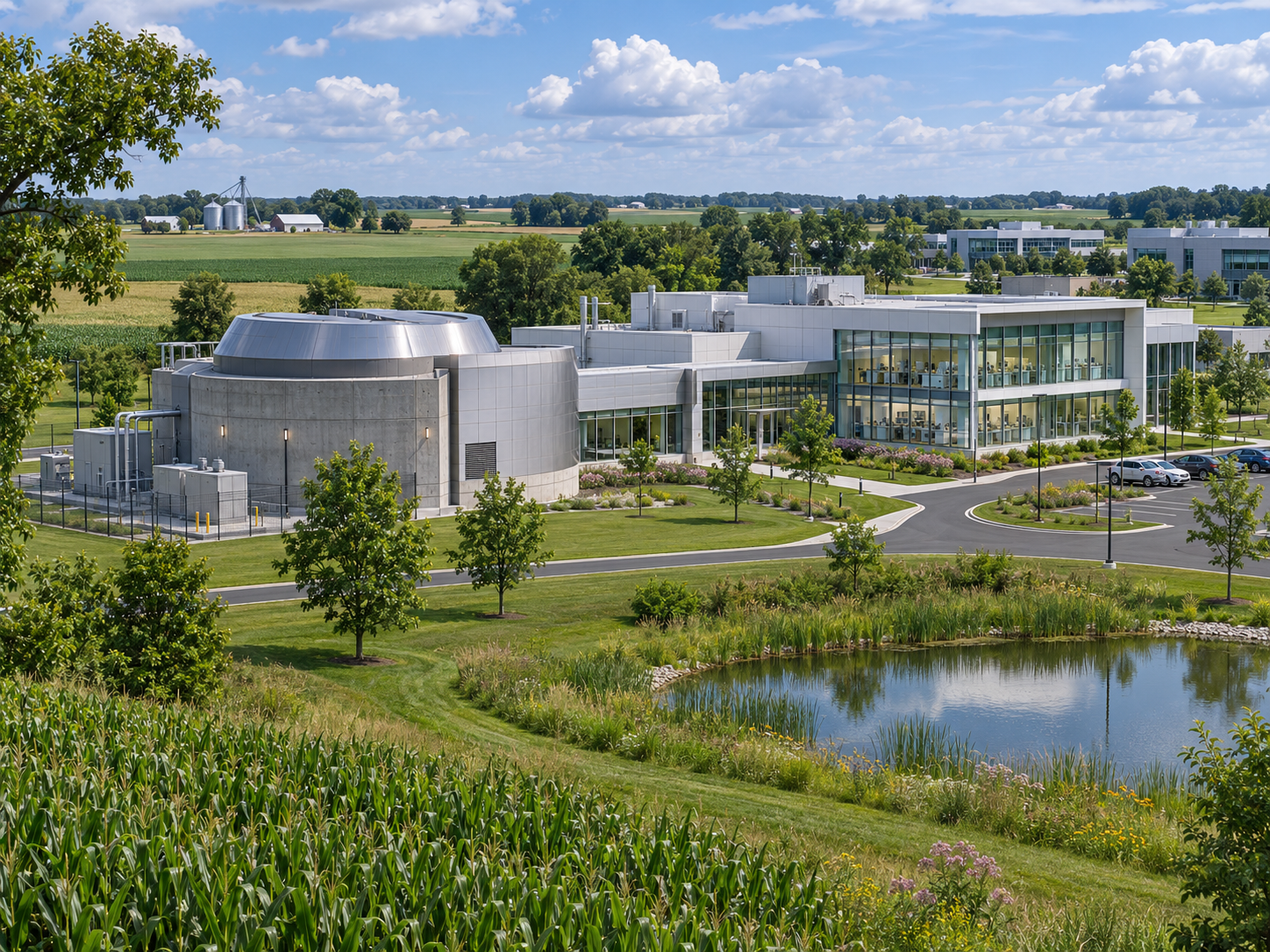
*AI-generated conceptual rendering of a futuristic nuclear medical research facility. For illustration only; this is not an official design, approved site plan, or depiction of the proposed Oklo facility.
A proposed medical isotope project at Boone County’s LEAP district is drawing scrutiny over taxpayer spending, potential nuclear activities, and the timing of public input.
Public records confirm that the Indiana Economic Development Corporation is seeking review of $20 million in land-acquisition funding for a project described as producing radio medicines. Reporting also identifies a larger land agreement with an Oklo subsidiary. However, the available information does not establish that a nuclear power plant serving Meta is planned for Boone County. in.gov
What the state is considering
The November 10 State Budget Committee agenda lists two requests for “Project Phoenix”: releasing the remaining $8 million and reallocating another $12 million previously designated for LEAP infrastructure and land purchases.
The agenda describes approximately 185 acres, including land options and deposits, for a company proposing investment of up to $1.5 billion. It says the acquired property would be sold to the company under a purchase-and-sale agreement. These requests concern land funding; the agenda does not constitute a nuclear construction or operating license. in.gov
Why residents are asking about reactors
IBJ reporting identifies Bigfoot Metals Development LLC as an Oklo subsidiary pursuing up to 440 acres at LEAP. A secondary account of that reporting describes a potential $70.4 million sale and says the agreement permits nuclear power generation as well as radioisotope production. Meanwhile, IBJ’s published summary attributes to Lebanon Mayor Matt Gentry the statement that the proposed project is only for medical isotope production. Inside INdiana Business
Those statements address different questions: what the land agreement permits and what officials say is currently proposed.
Broadly permitted uses do not prove that every activity will be built. They do make the agreement’s restrictions, future-use provisions, and approval requirements important public questions.
The underlying signed agreement was not independently obtained for this article. Its reported provisions should therefore be understood as attributed reporting, rather than findings from a direct contract review.
Medical isotope production can involve reactors
“Medical isotope production” describes a facility’s purpose. It does not fully explain how its products would be made.
Oklo’s isotope business includes nuclear reactor technology. In an October announcement, the company described its planned Groves-2 Forge project as combining reactor irradiation with processing, separation, packaging, and transportation capabilities. Its initial focus is lutetium-177, an isotope used in targeted cancer treatments. oklo.com
That provides a legitimate reason for residents to request technical details. It does not establish which equipment, reactor design, or number of reactors would be proposed for LEAP.
A useful public presentation should explain both the medical products and the nuclear processes involved in producing them.
What the radioactive-waste research says
Nuclear reactors generate radioactive waste, including spent fuel and materials made radioactive during operation. A medically focused project still needs a clear waste-management plan. Nuclear Regulatory Commission
The widely circulated claim that small modular reactors can produce two to 30 times greater waste volumes per unit of energy comes from a 2022 study published in the Proceedings of the National Academy of Sciences. Researchers examined three reactor designs developed by NuScale, Toshiba, and Terrestrial Energy. Results varied by design and waste category. Stanford Report
That finding is not a measured forecast for Boone County. The study did not evaluate a disclosed LEAP facility design, and it should not be summarized as proof that every small reactor produces 30 times more spent fuel.
Residents need project-specific estimates covering waste quantities, radioactivity, storage duration, transportation, disposal destinations, and responsibility for costs. It is also premature to assert that this particular project would require both cooling pools and dry-cask storage without knowing its fuel, design, and approved storage arrangements.
Is there a confirmed Meta connection?
Oklo has announced an agreement with Meta supporting a proposed nuclear power campus of up to 1.2 gigawatts in Pike County, Ohio. That announcement identifies an Ohio location and a phased development plan. oklo.com
The sources reviewed for this article do not establish that the LEAP medical isotope proposal would supply electricity to Meta’s Boone County development. A corporate relationship elsewhere is not sufficient evidence of a local power arrangement.
The timing of public input
The State Budget Committee business meeting was scheduled for November 10 at 3 p.m. Eastern in Statehouse Room 431, 200 W. Washington Street, Indianapolis. The state provides a meeting-video link through its Budget Committee webpage. An approval or denial has not been verified for this article. in.gov
Radio Mom reports that Boone EDC has invited residents to meet Oklo representatives on Monday, November 16, from 4–6 p.m. at the Boone County Fairgrounds Annex Building. The scheduled budget review therefore precedes that community event by six days. radiomom.org
That sequence creates a concrete accountability question: what information should residents receive before the state commits additional resources?
Questions deserving specific, public answers include:
- What reactor technology, fuel, number of units, and operating scale are proposed?
- Is electricity generation planned, and could it be added later?
- Which agencies would oversee licensing, environmental review, inspections, and public participation?
- What are the projected water needs, wastewater streams, and radioactive releases?
- Where would radioactive waste be stored, shipped, and disposed of?
- Who would pay for long-term waste management and decommissioning?
- What financial protections apply if the project changes, stalls, or fails?
The potential medical benefits deserve explanation. So do the nuclear activities, public costs, and long-term obligations. Residents should be able to evaluate all of them through accessible documents and clear answers.
Research note: The original Sierra Club statement, forwarded committee contact list, and stated sign restrictions were not independently verified and have not been reproduced as established facts.
Related Posts


Comments (0)